> For the complete documentation index, see [llms.txt](https://docs.ndi.video/all/llms.txt). Markdown versions of documentation pages are available by appending `.md` to page URLs; this page is available as [Markdown](https://docs.ndi.video/all/developing-with-ndi/utilities/unreal-engine-sdk/advanced.md).
# Advanced
### NDI Broadcast Configuration
Essential properties used for modifying the broadcast configuration for an NDI Media Sender.
The NDI Broadcast Configuration structure is used when initializing or changing the broadcast configuration of an NDI Media Sender object.
### NDI Connection Information
Defines a collection of properties which describe the Source Information for NDI® connections. This structure is returned ***by Find Network Source by Name.*** Obtaining the NDI Source Information is the first step before connecting to an NDI source on the network.
To get NDI Source Information, call the “Blueprint Library Function” called ***Find Network Source By Name.*** To get a collection of multiple NDI Source Information structures, call **Get NDI Source Collection.** \
\
The collection can be iterated and used to “Start Broadcasting” or “Change Connection Information” on an Input Source object.
### NDI Receiver Performance Data
List of commands that provide detailed information on an NDI source and sender.
To get an NDI Receiver Performance Data structure, call the GetPerformanceData function on an NDI Receiver Component object in blueprints. This data can be useful for determining how strong/reliable the connection to the NDI® sender is.
### NDI Broadcast Component
Provides a wrapper around the NDI Media Sender to access functionality from Blueprints and perform simple broadcasting functionality.
| Properties | |
| --------------------------------- | ----------------------------------------------------------------------------------------------------------------------------- |
| NDIMediaSource(UNDIMediaSender\*) | A pointer to the Media Sender object representing the configuration of the network source to send audio, video, and metadata. |
Adding the ***NDI Broadcast Component*** to an Actor in blueprints give your actor functionality for broadcasting audio, video, and metadata frames over NDI®.
The NDI Broadcast Component allows users to **dynamically change the broadcast texture** during runtime. This is useful for switching between different cameras, scene views, or dynamically generated content.
### NDI Finder Component
Provides a component used for essential functionality when dealing with finding NDI® sources on the network allowing you to get a collection of sources as well as listen for events when the source collection has changed.
| Functions | |
| ------------------------------------------------------------- | -------------------------------------------------------------------- |
| FindNetworkSourcebyName (FNDIConnectionInformation&, FString) | Attempts to find a network source by the supplied name. |
| GetNetworkSources() (TArray) | Returns the current collection of NDI® sources found on the network. |
Adding the NDI Finder Component to an Actor in blueprints give your actor functionality for finding NDI® sources on the network. This retrieves a collection of network sources as well as notifies of changes to the NDI® source collection.
### NDI Receiver Component
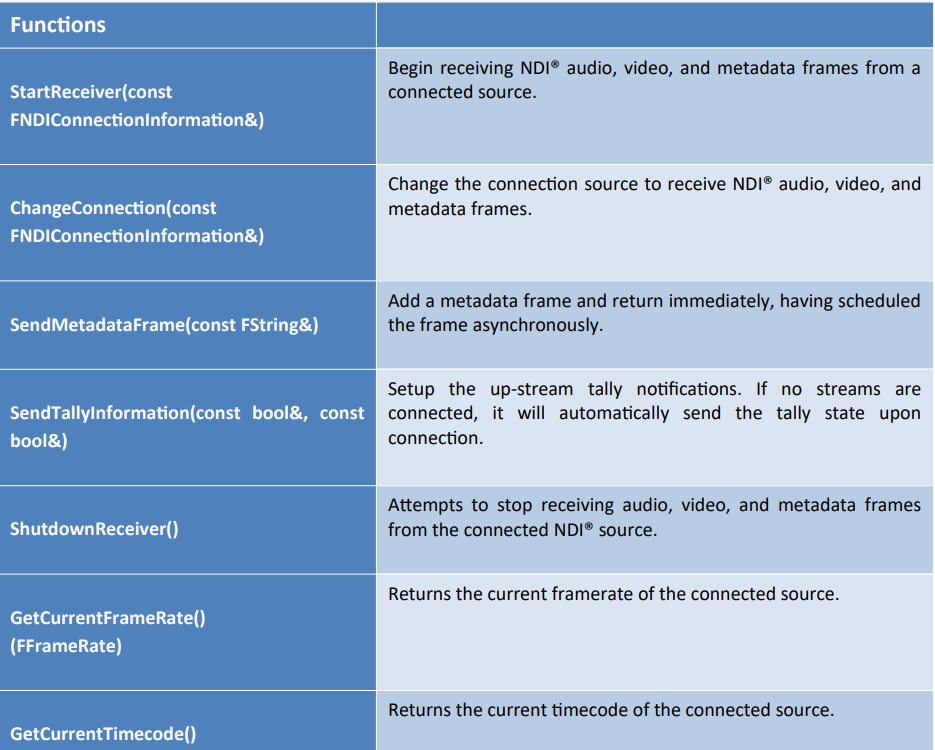
Provides a wrapper around the NDI Media Receiver to access functionality from Blueprints and perform simple receiver functionality.
Adding the NDI Receiver Component to an Actor in blueprints give your actor functionality for receiving audio, video, and metadata frames from a connected NDI® sender.
### NDI Viewport Capture Component
Provides a component to be used to capture additional viewports for broadcasting over NDI®
Adding the NDI Viewport Capture Component to an Actor in blueprints give your actor functionality for rendering the viewport, while providing audio, video, and metadata frames from a connected NDI® sender.
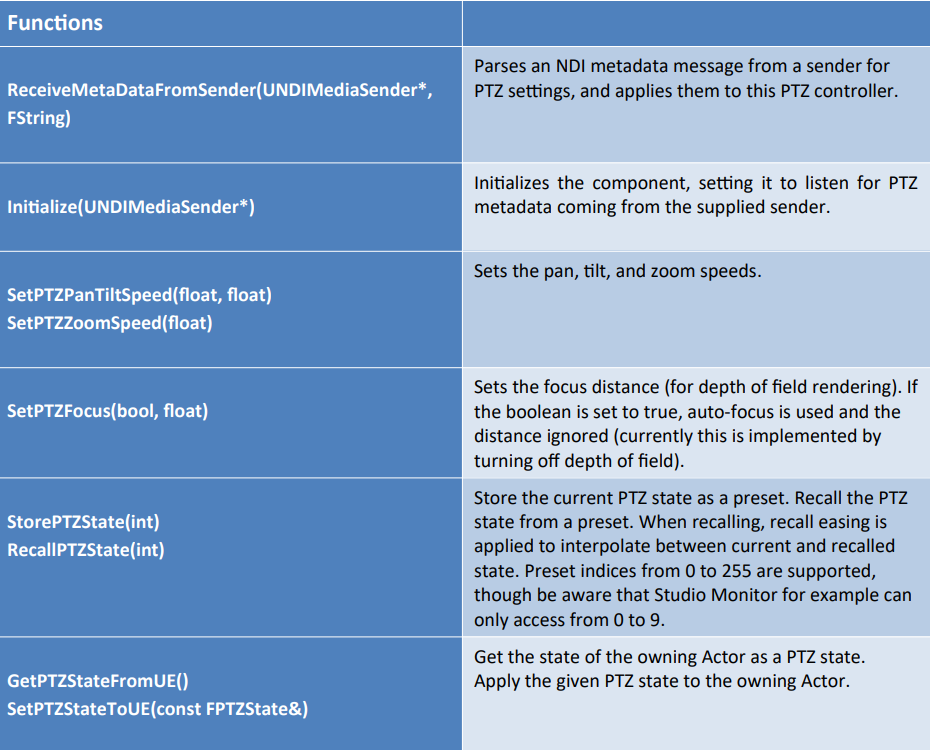
### NDI PTZ Controller Component
Provides a component for PTZ control from an NDI® sender. Typically this is part of an NDI® Broadcast Actor. It can also be applied to any other type of Actor, with some limited functionality.
### NDI Media Receiver
Content used to provide functionality for receiving audio, video, and metadata frames over NDI® to a connected NDI® sender.
Creating an NDI Media Receiver will provide configuration details to an NDI Receiver Component. Using the context menu of the content browser, you can create an NDI Media Receiver using the menu “Media” and locating the “NDI Media Receiver” entry. This will allow you to create a virtually unlimited number of NDI® receiver objects.
The **NDI Media Receiver Asset** can also receive metadata embedded in an incoming NDI stream. This metadata can be used for triggering **Unreal Engine** events**,** synchronizing assets, or passing data between NDI-enabled applications. Metadata processing can be accessed through Blueprint scripting or C++ functions.
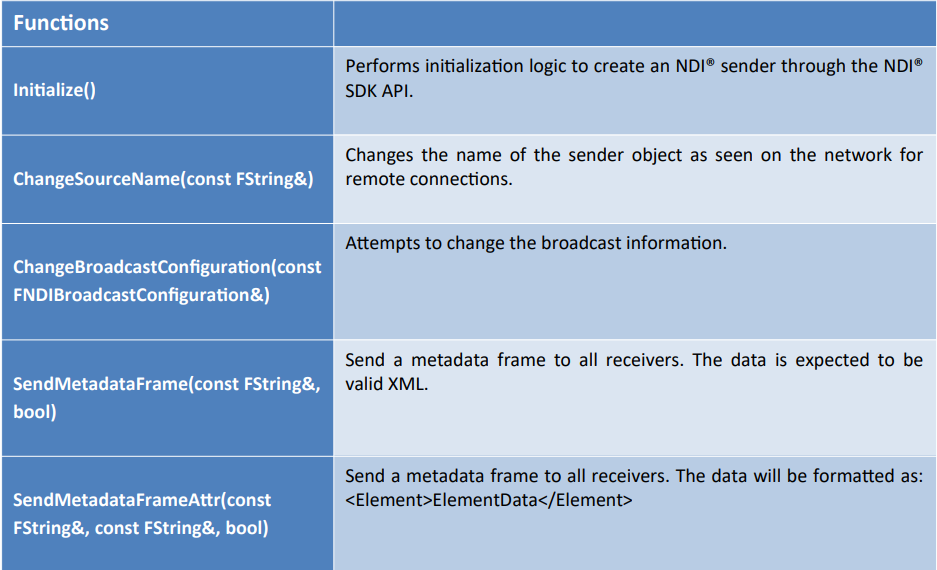
### NDI Media Sender
Creating an NDI Media Sender will provide configuration details to an NDI Broadcast Component or NDI Viewport Capture Component. \
\
Using the context menu of the content browser, you can create an NDI Media Sender using the Media menu and locating the “NDI Media Sender” entry. This allows you to create a virtually unlimited number of NDI® sender objects.
In addition to video and audio streaming, the **NDI Media Sender Asset** supports **metadata transmission**. This allows Unreal Engine to send **custom metadata, such as timestamps, event triggers, or custom JSON/XML data**, along with the video feed. Receivers supporting metadata can use this information to synchronize events, control external applications, or enhance real-time workflows.
### NDI Media Sound Wave
An NDI® IO Plugin specific SoundWave object used to provide functionality for playback of NDI® audio frames from an NDI® sender.
Creating an NDI Media Sound Wave will provide configuration details to an “NDI Reciever Component”. \
\
Using the context menu of the content browser, you can create an NDI Media Sound Wave using the menu Sounds
### NDI Media Texture 2D
An NDI® IO Plugin specific Texture2D object used to provide functionality for playback of NDI® video frames from an NDI® sender. Creating an “NDI Media Texture2D” will provide a texture object used by an NDI Media Receiver. Using the context menu of the content browser, you can create a NDI Media Texture 2D using the menu Materials and Textures, and locating the “NDI Media Texture 2D” option.
### NDI Broadcast Actor
An Actor which can be added to the scene that renders a new video texture from the viewpoint of the actor’s transform. Provides support for broadcasting the texture as a video frame to connected to an NDI® receiver.
Adding an “NDI Broadcast Actor” to a scene will provide an easy way to render a viewport to be sent over NDI® to connected NDI® receivers. You can find the “NDI Broadcast Actor” in the sub menu of “NDI®” within the Modes panel in the editor for your project.
### NDI Receive Actor
An Actor you can add to the scene to display NDI® sender audio, video, and metadata frames in the virtual scene
Adding an “NDI Receive Actor” to a scene will provide an easy way to show video in a virtual environment. You can find the NDI Receive Actor in the “NDI®” sub menu within the “Modes” panel in the editor for your project.
---
# Agent Instructions
This documentation is published with GitBook. GitBook is the documentation platform designed so that both humans and AI agents can read, navigate, and reason over technical content effectively. Learn more at gitbook.com.
## Querying This Documentation
If you need additional information that is not directly available in this page, you can query the documentation by asking a question.
Perform an HTTP GET request on the following URL with the `ask` and `goal` query parameters:
```
GET https://docs.ndi.video/all/developing-with-ndi/utilities/unreal-engine-sdk/advanced.md?ask=&goal=
```
`ask` is the immediate question: it should be specific, self-contained, and written in natural language.
`goal` is what the user is ultimately trying to achieve, the reason they need the answer. Sharing it helps GitBook give you a better, more relevant answer. A goal is most helpful when it describes the outcome the user wants rather than restating the question. For example, with `ask=how do I create an API token`, a goal like `automate deployments from our CI pipeline` lets GitBook tailor the answer to that use case.
The response will contain a direct answer to the question and relevant excerpts and sources from the documentation.
Use this mechanism when the answer is not explicitly present in the current page, you need clarification or additional context, or you want to retrieve related documentation sections.