> For the complete documentation index, see [llms.txt](https://docs.ndi.video/all/llms.txt). Markdown versions of documentation pages are available by appending `.md` to page URLs; this page is available as [Markdown](https://docs.ndi.video/all/using-ndi/ndi-tools/ndi-tools-for-windows/screen-capture-hx.md).
# Screen Capture HX
Elevate Your Network Display Experience.
**NDI Screen Capture HX** provides features comparable to [NDI Screen Capture](/all/using-ndi/ndi-tools/ndi-tools-for-windows/screen-capture.md), but it uniquely leverages GPU acceleration.
This ensures low-latency video delivery, supporting resolutions up to 4K and frame rates of 120 Hertz or higher, using H.264[^1] or HEVC[^2] compression. GPU acceleration significantly reduces your system's CPU workload, enhancing overall efficiency.
{% hint style="info" %}
Download NDI Tools [here](https://ndi.video/tools/download/).
{% endhint %}
***
## **Accessing NDI Screen Capture HX**
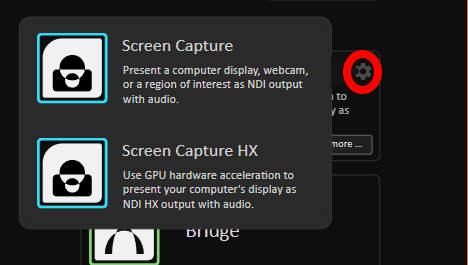
Screenshot of NDI Launcher
In the [NDI Launcher](/all/using-ndi/ndi-tools/ndi-tools-launcher.md), select the configuration gear to choose between two distinct versions of NDI Screen Capture. Select Screen Capture HX.
***
## **Sharing Your Screen**
The application will appear in your system tray with the NDI logo. Upon launch, your computer's desktop video and audio are shared and viewable from any NDI-enabled device on your network.
***
## **Viewing on NDI-Enabled Devices**
View the output of Screen Capture on another NDI-enabled device using an application like [Studio Monitor](/all/using-ndi/ndi-tools/ndi-tools-for-windows/studio-monitor.md).
**Right-click on the screen** and select the device name and corresponding NDI stream.
***
## **Settings and Customization:**
**NDI Screen Capture** is an application designed to effortlessly share your computer's desktop video and audio with any other device on your network through an NDI stream.
Whether you're conducting broadcasts and presentations, collaborating on projects, creating tutorials, or engaging in media playback, Screen Capture provides a valuable solution.
***
## **Accessing NDI Screen Capture**
[Install NDI Tools](/all/using-ndi/ndi-tools/installing-ndi-tools.md) and run NDI Screen Capture from the [NDI launcher](/all/using-ndi/ndi-tools/ndi-tools-launcher.md) or your applications list.
***
## **Sharing Your Screen**
The tool will appear in your system tray with the NDI logo. Upon launch, your computer's desktop video and audio are viewable from any NDI-enabled device on your network.
***
## **Viewing on NDI-Enabled Devices**
View the output of Screen Capture on another NDI-enabled device using an application like [Studio Monitor](/all/using-ndi/ndi-tools/ndi-tools-for-windows/studio-monitor.md).
**Right-click on the screen** and select the device name and corresponding NDI stream.
***
## **Settings and Customization**
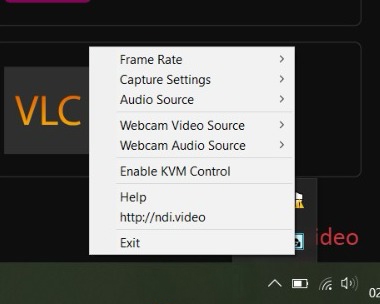
Right-click on the NDI Screen Capture app icon on the system tray to access different settings.
Right-click on the NDI Screen Capture icon to access different settings:
* **Bandwidth**\
This feature enables the selection from three distinct bandwidth presets and specifies the codec used for NDI HX compression, H.264 or HEVC.
* **Resolution**\
It allows the native screen resolution or downscaling the stream in lower resolutions.
* **Framerate**\
This option allows to specify the NDI stream framerate[^3].
* **Audio Source**\
Specify a particular audio source to be embedded into the NDI stream created by the NDI Screen Capture.
* **Capture Mouse Pointer**
* **KVM Control**\
The KVM[^4] option in NDI Screen Capture allows for remote computer control over a network. When this feature is enabled, you can not only capture and send the computer's screen over the network using NDI but also remotely control the computer's keyboard and mouse inputs from another device.
* **Help**\
Access the Screen Capture Help Assistant and a quick web link to [ndi.video](https://ndi.video/) for more information about NDI and NDI Tools.
***
{% hint style="info" %}
Was this helpful? Please let us know by rating this page; you can also leave a [review](https://forms.office.com/Pages/ResponsePage.aspx?id=pzs8xttADka98eY6AqOtWZeUcJXxBylLhfBY94EFe29UNjZRV0xTOFdHR09INzRaN1BDVFFWT0lNRi4u).
{% endhint %}
[^1]: Advanced Video Coding (AVC), also called **H. 264**, is the most common video compression standard used today. AVC/H. 264 can encode high-quality video at lower bit rates than older compression standards.
[^2]: High Efficiency Video Coding (**HEVC**), also known as H.265 and MPEG-H Part 2, is a [video compression standard](https://en.wikipedia.org/wiki/Video_coding_format) designed as part of the [MPEG-H](https://en.wikipedia.org/wiki/MPEG-H) project as a successor to the widely used [Advanced Video Coding](https://en.wikipedia.org/wiki/Advanced_Video_Coding) (AVC, H.264, or [MPEG-4](https://en.wikipedia.org/wiki/MPEG-4) Part 10). In comparison to AVC, HEVC offers from 25% to 50% better [data compression](https://en.wikipedia.org/wiki/Data_compression) at the same level of [video quality](https://en.wikipedia.org/wiki/Video_quality).
[^3]: Frame rate is the measurement of how quickly a number of frames appears within a second, which is why it's also called FPS (frames per second).
[^4]: **KVM** stands for “Keyboard, Video (monitor), Mouse.” The main function of a KVM switch is to control, switch between, and manage multiple PCs or servers via a single keyboard, monitor, and mouse (also referred to as the 'console').
---
# Agent Instructions
This documentation is published with GitBook. GitBook is the documentation platform designed so that both humans and AI agents can read, navigate, and reason over technical content effectively. Learn more at gitbook.com.
## Querying This Documentation
If you need additional information that is not directly available in this page, you can query the documentation by asking a question.
Perform an HTTP GET request on the following URL with the `ask` and `goal` query parameters:
```
GET https://docs.ndi.video/all/using-ndi/ndi-tools/ndi-tools-for-windows/screen-capture-hx.md?ask=&goal=
```
`ask` is the immediate question: it should be specific, self-contained, and written in natural language.
`goal` is what the user is ultimately trying to achieve, the reason they need the answer. Sharing it helps GitBook give you a better, more relevant answer. A goal is most helpful when it describes the outcome the user wants rather than restating the question. For example, with `ask=how do I create an API token`, a goal like `automate deployments from our CI pipeline` lets GitBook tailor the answer to that use case.
The response will contain a direct answer to the question and relevant excerpts and sources from the documentation.
Use this mechanism when the answer is not explicitly present in the current page, you need clarification or additional context, or you want to retrieve related documentation sections.