> For the complete documentation index, see [llms.txt](https://docs.ndi.video/all/llms.txt). Markdown versions of documentation pages are available by appending `.md` to page URLs; this page is available as [Markdown](https://docs.ndi.video/all/using-ndi/ndi-tools/plugins/audio-direct.md).
# Audio Direct
Unleash High-Quality Audio Distribution.
**NDI Audio Direct** is a collection of VST audio plugins for MS Windows designed to integrate seamlessly with virtually any audio software application, allowing you to harness the power of NDI. (Available for **Windows** only**)**
This innovative tool empowers users to select, receive, and generate multichannel audio with exceptional quality and minimal latency.
It facilitates easy Audio over IP, supporting workflow both on-premises and in virtual or cloud environments, and it's compatible with any digital audio workstation through VST plugins.
{% hint style="info" %}
Download NDI Tools [here](https://ndi.video/tools/download/).
{% endhint %}
***
## **Accessing NDI Audio Direct**
[Install NDI Tools](/all/using-ndi/ndi-tools/installing-ndi-tools.md). After installing it, access NDI Audio Direct from any digital audio workstation program.
{% hint style="info" %}
By default, the NDI Audio Direct VST plugin is installed on C:\Program Files\Common Files\VST3. You can set your software's VST plugin location to this path or copy them to a folder of your choice.
{% endhint %}
***
## Using the NDI Plugin With DAW[^1]
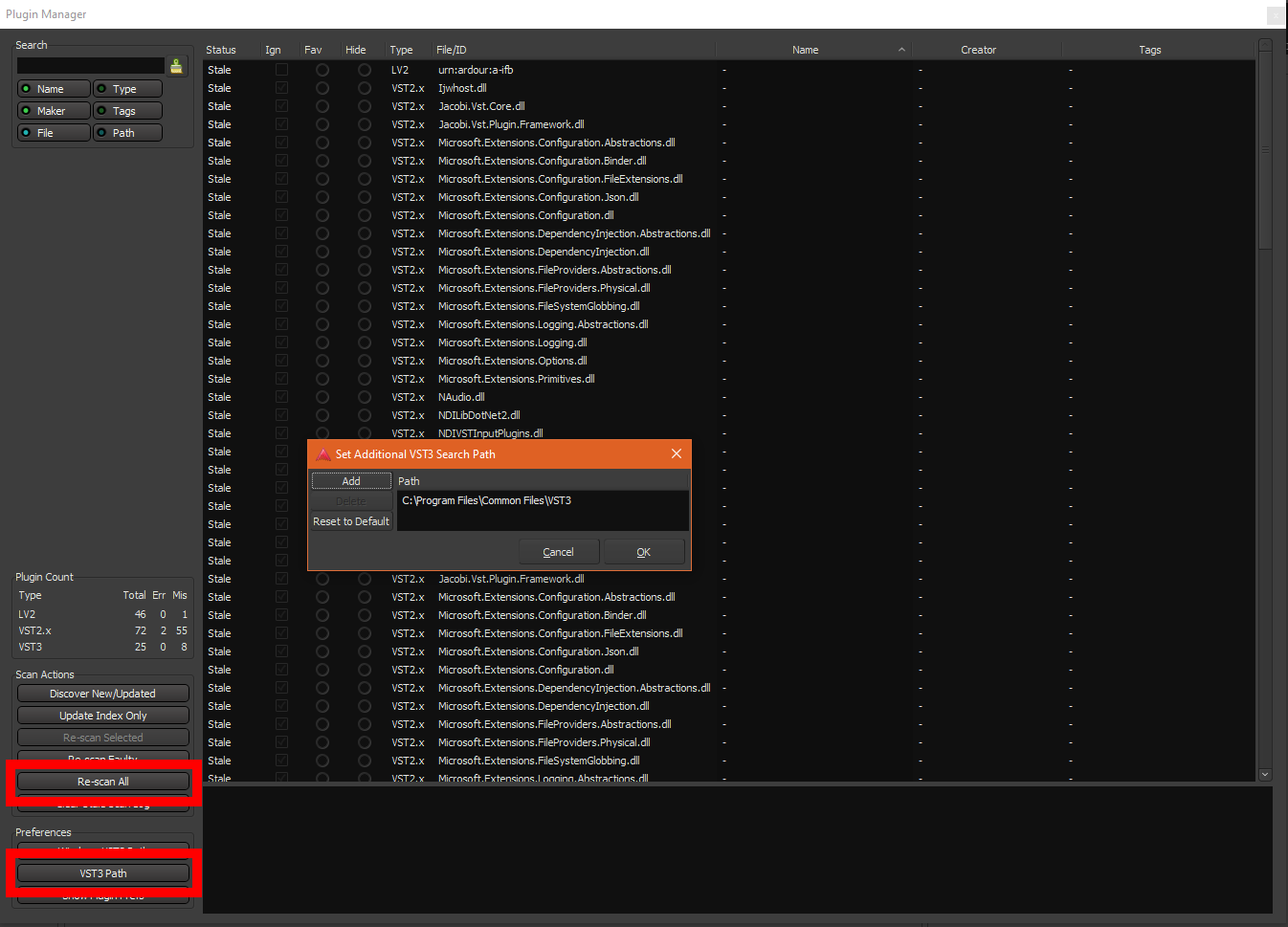
In your DAW application, look for the VST plugin settings menu (the location is specific to each DAW) and check if the **VST3** path is correctly configured, then perform the plugin re-scan. This will load the NDI Plugin in the DAW application.
Here is the Plugin Management interface in Ardour:
Screenshot of Plugin Management menu on Ardour DAW
***
## **NDI Input settings**
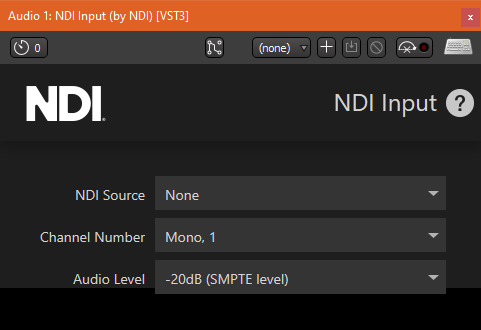
When you load the NDI Input plugin in your DAW, you'll see a menu to configure the following settings:
* **NDI source**
* **Number and configuration of Audio Channels:** NDI Audio Direct supports up to 16 audio channels in different configurations.
* **Audio Level:** You can adjust the source level to match your DAW level setting.
Screenshot of NDI Input settings menu (Windows)
***
## **NDI Output settings**
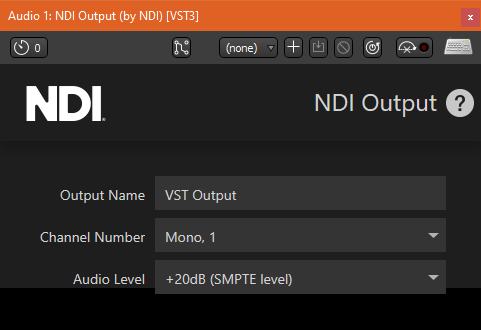
When you load the NDI Output plugin in your DAW, you'll see a menu to configure the following settings:
* **The NDI Output**
* **Number and Audio Channels configuration**: NDI Audio Direct supports up to 16 audio channels in different configurations.
* **Audio Level:** You can adjust the source level to match your level destination.
Screenshot of NDI Output settings menu (Windows)
[^1]: Acronym for Digital Audio Worksation, a DAW is used for [recording](https://en.wikipedia.org/wiki/Sound_recording_and_reproduction), editing and producing [audio files](https://en.wikipedia.org/wiki/Audio_files). DAWs come in a wide variety of configurations from a single software program on a [laptop](https://en.wikipedia.org/wiki/Laptop), to an integrated stand-alone unit, all the way to a highly complex configuration of numerous components controlled by a central computer.
---
# Agent Instructions
This documentation is published with GitBook. GitBook is the documentation platform designed so that both humans and AI agents can read, navigate, and reason over technical content effectively. Learn more at gitbook.com.
## Querying This Documentation
If you need additional information that is not directly available in this page, you can query the documentation by asking a question.
Perform an HTTP GET request on the following URL with the `ask` and `goal` query parameters:
```
GET https://docs.ndi.video/all/using-ndi/ndi-tools/plugins/audio-direct.md?ask=&goal=
```
`ask` is the immediate question: it should be specific, self-contained, and written in natural language.
`goal` is what the user is ultimately trying to achieve, the reason they need the answer. Sharing it helps GitBook give you a better, more relevant answer. A goal is most helpful when it describes the outcome the user wants rather than restating the question. For example, with `ask=how do I create an API token`, a goal like `automate deployments from our CI pipeline` lets GitBook tailor the answer to that use case.
The response will contain a direct answer to the question and relevant excerpts and sources from the documentation.
Use this mechanism when the answer is not explicitly present in the current page, you need clarification or additional context, or you want to retrieve related documentation sections.